Brachyglottis rotundifolia, Puheretaiko, or muttonbird scrub that is endemic to the South and Stewart Island’s. It is a large leathery shrub growing 1.8-6m tall or more, that inhabits coastal shrub in the western and southern South Island southwards. It has dark green, thick and leathery leaves with white or tan fuzz underneath. It has small insignificant white flowers. It is frost hardy and grows well in dry situations, but best results can occur if planted in moist soil in well drained sites. It does not like high humidity and prefers good airflow at all times.
Tuesday, 6 August 2019
Tuesday, 30 July 2019
Container Planting
You can grow any plants in a container, as that is how they are grown in a nursery situation, but some plants are better suited for growing in containers for extended periods.
With the size of average sections shrinking and people
building outdoor lifestyle areas near their houses container gardening has
become a popular way of growing plants, giving many advantages. A wide range of
looks can be achieved with the use of various different pots and these can be
moved around to suit the setting and indeed completely change the landscape.
Many New Zealand plants are suitable for growing in
containers, both for outdoor and indoor use. Larger tubs and containers can be
used on patios, terraces and decks, or simply as a feature in the garden or at
the entrance.
The main points when
container planting are as follows:
A suitable
container. Choice of a container is important. Its external appearance must
suit the situation that it is to be placed. It must be large enough that the
plant does not quickly out grow it. The container should be shaped so that it
is easily moved and repotted if necessary.
A suitable growing
medium. There are a number of growing mediums that can be used for
container planting but the most important thing is that they have a supply of
long-lasting nutrients and are reasonably resistant to drying out. A soil based
mix or peat based potting medium can be used with the addition of slow release
fertilizers that can be in granules or a tablet form, and water retentive
products like gels, granules or sphagnum moss.
Adequate drainage.
It is important the chosen container has adequate drainage. That it has
sufficient holes that allow the surplus water to drain away and that they do
not become blocked, and that you use sufficient drainage material in the base.
Suitable plants
for the situation. Choosing a plant for the situation is important. Being
aware that you choose a plant that will suit your needs, but also that the
plant is suitable for the conditions of the site, e.g. not using a sun loving
plant in a shady, cool site.
Regular
maintenance. Container plants need regular maintenance. Watering is the
most important and even a few days neglect can result in leaf fall. Once
the plant has become well established it is important to regularly feed the
plant to maintain a healthy growing condition. Also repotting of the plant can
be done every 2 years. It is also important to regularly remove dead and dying
foliage that may encourage fungal disease, and to periodically check the plant
for pests and diseases.
Trees for Canterbury have a number of plants available
that are suitable for container planting, and you can pick up an information
sheet at the nursery, as well as getting advise from staff.
Wednesday, 24 July 2019
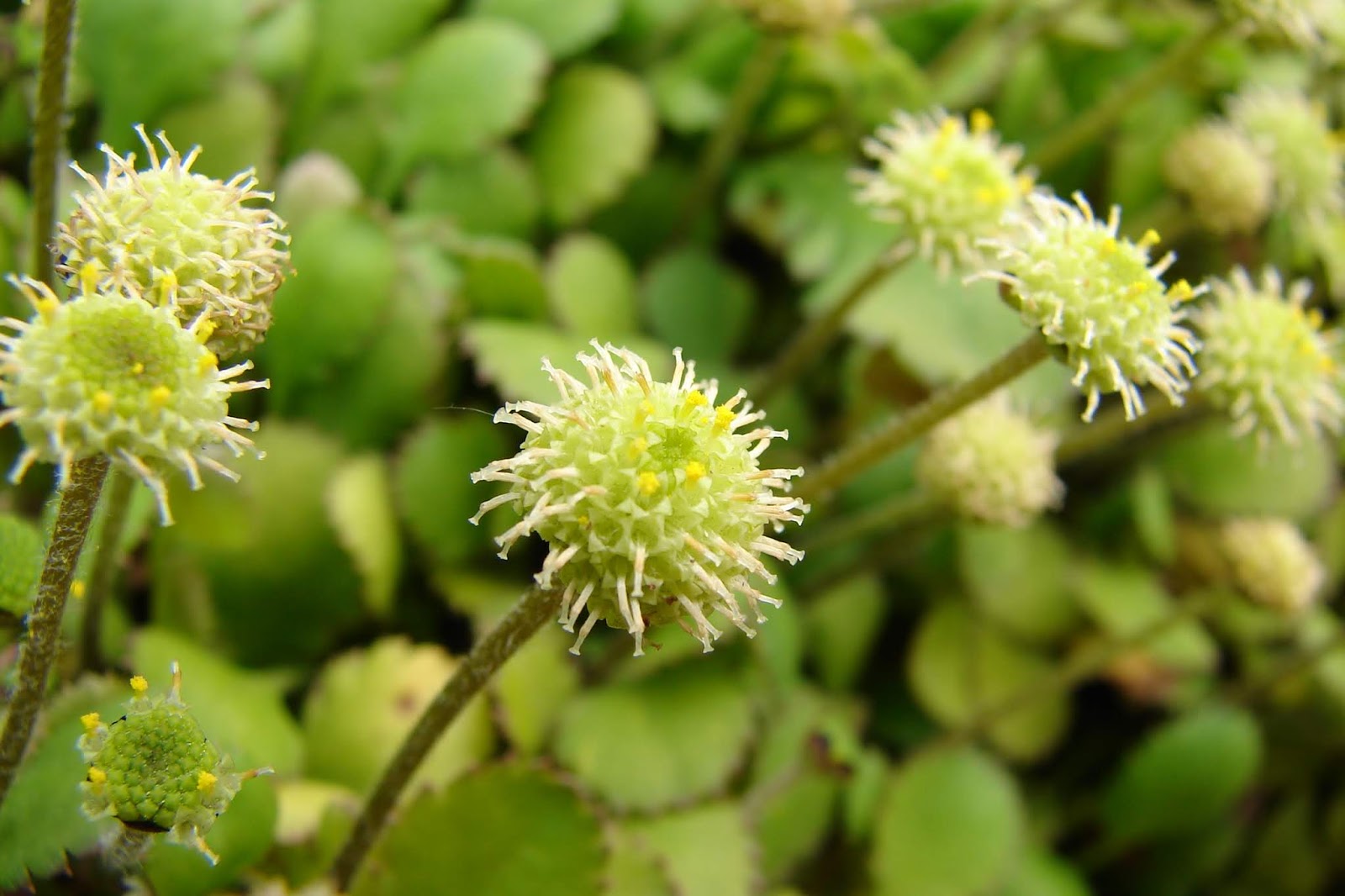
Leptinella rotundata, or
Northland button daisy is endemic to the North Island. This nationally endangered
species grows on exposed areas on coastal cliffs and boulder falls amongst low
vegetation in areas from the Waitakere Range north to Scott's Point, Te Paki
which is just south of Cape Maria Van Diemen. It occupies a very specific
habitat, preferring the wind and salt blasted margins of vegetated cliff faces,
where other competing plants are held in check. It is typically sparse and
patchy in its distribution at any given site. It is a small creeping, hairy
herbaceous plant, sparingly branched, that forms diffuse patches. It has thick,
yellowish, sparsely hairy, rounded leaves that are about 15 mm long, with
toothed margins on a long stalk. Flowering generally occurs on separate male
and female plants from August to January, but sporadic flowering can occur at
any time of the year. The flower stems are up to 60 mm long and have a single
yellow-green, button-like flowerhead. The species was rediscovered in April
2010, in the Waitakere Ranges some 113 years after it was first found there by
Thomas Cheeseman, and 104 year after it was described by him as new to science
from those gatherings. It is threatened at all known locations by
coastal erosion, weed invasion of its narrow cliff-top and boulder bank
habitats, and by the seemingly natural separation of male and female plants.
Thus in the wild, as far as is known, seed is rarely if ever formed.
Sunday, 21 July 2019
Carex albula or white sedge is endemic to the South Island in a narrow area from the Mackenzie Basin, Waitaki and Central Otago from 200-750m asl. A species of mainly alluvial terraces, colluvial slopes and river flats. It prefers free draining soils and is often a local component of grey scrub communities. Seemingly unpalatable it often persists in paddocks alongside cattle and sheep. It is a stiffly erect to drooping, buff-coloured to almost bleached white, green or red, densely tufted sedge, 250-350 mm tall. Its appearance can become very white particularly during the colder months. It is quite often confused for Carex comans ‘Frosted Curls’, and the peculiar bleached-white colour implied by the specific name is only apparent in some plants and is often imparted by the dead foliage (which is retained). It is best suited for a well drained, sunny site in dry climates. This species dislikes humidity and soon dies if kept too moist. Although it does not seem to be particularly palatable as it is often found in some abundance within pasture otherwise heavily cropped by sheep and/or cattle, plants have been lost to spraying and cultivation. It also does not seem to tolerate competition from taller species.
Wednesday, 17 July 2019
Brachyglottis lagopus, Mountain daisy, or Yellow rock daisy is a small flowering rosette herbaceous perennial native to New Zealand. It is found in the North Island from Taupo south and to Canterbury in the South Island, from coastal to low alpine from near sea-level to 1500m asl, in open scrub, snow tussock, herbfields, rock crevices and grasslands. It prefers moist humus-rich soil perhaps a little gritty, in damp shady areas but will often succeed when self-sown into rock crevices. It is a variable species, with green leaves that can be hairy, and can vary in shape and size (often as big as 20 x 15cm) depending on the area. In older plants, the hairs become sparse on the top surface but the under surface is always covered in woolly tomentum. Its flowers are yellow and appear throughout the year (from September to June, but mostly December to April) on stalks that are up to 35cm high, followed by fluffy seed heads for wind dispersal.
Monday, 8 July 2019
Veronica (Hebe) amplexicaulis f. hirta, syn. Veronica (Hebe) allanii is endemic to the South Island. This naturally uncommon plant is confined to Mount Peel in South Canterbury in low montane to subalpine (mostly subalpine) in tussock grassland and on steep-sided rock outcrops, where it grows in joints and crevices, gorges and more rarely boulder falls, usually at 300 - 1200m asl. A small to medium-sized low growing shrub, branching from the base, is seldom more than 30cm tall with spreading branches, that are glaucous and uniformly pubescent (hairy). Leaves are also hairy. White flowers from late spring to early summer. Prefers a sunny site and should be planted in a free draining soil, and dislikes humidity. Similar to Veronica (Hebe) pareora from which it is distinguished by its usually shorter stems, smaller leaves, pubescent peduncles, and usually non-pedicellate flowers (some plants in the upper Rangitata area have inflorescences whose basal flowers are pedicellate). V. amplexicaulis f. amplexicaulis differs from f. hirta by its glabrous leaves and mostly glabrous branchlets.
Thursday, 4 July 2019
Carmichaelia appressa or Kaitorete prostrate broom is endemic to Banks Peninsula, and is only found on Kaitorete Spit. It is found growing on flat, windswept, stony and sandy ground at sea-level.There are some intermediate forms on the adjacent south coast of Banks Peninsula. It is a more or less prostrate shrub, often forming patches up to 3m in diameter that are completely flattened against the ground Although it can be variable and often taller growing, and linked by intermediate forms to the erect bushy forms of common native broom. It has small white flowers with purple markings from October to December.
Subscribe to:
Posts (Atom)
Leptinella squalida subsp. mediana is endemic to the South and Stewart Islands. It is found from northwest Nelson and inland Marlborough to...
-
Carpodetus serratus, putaputaweta, or marble-leaf is endemic to the North, South and Stewart Islands. It is found from sea-level to 1000m a...
-
Clematis 'Purity’ is a cultivar of Clematis fosterii and Clematis paniculata, that was bred by the late Mr Arthur Ericson of Akaroa for...
-
Scleranthus biflorus occurs in the North & South Islands, but also in Tasmania, Australia and in South America. It is common around the ...