Monday, 27 January 2020


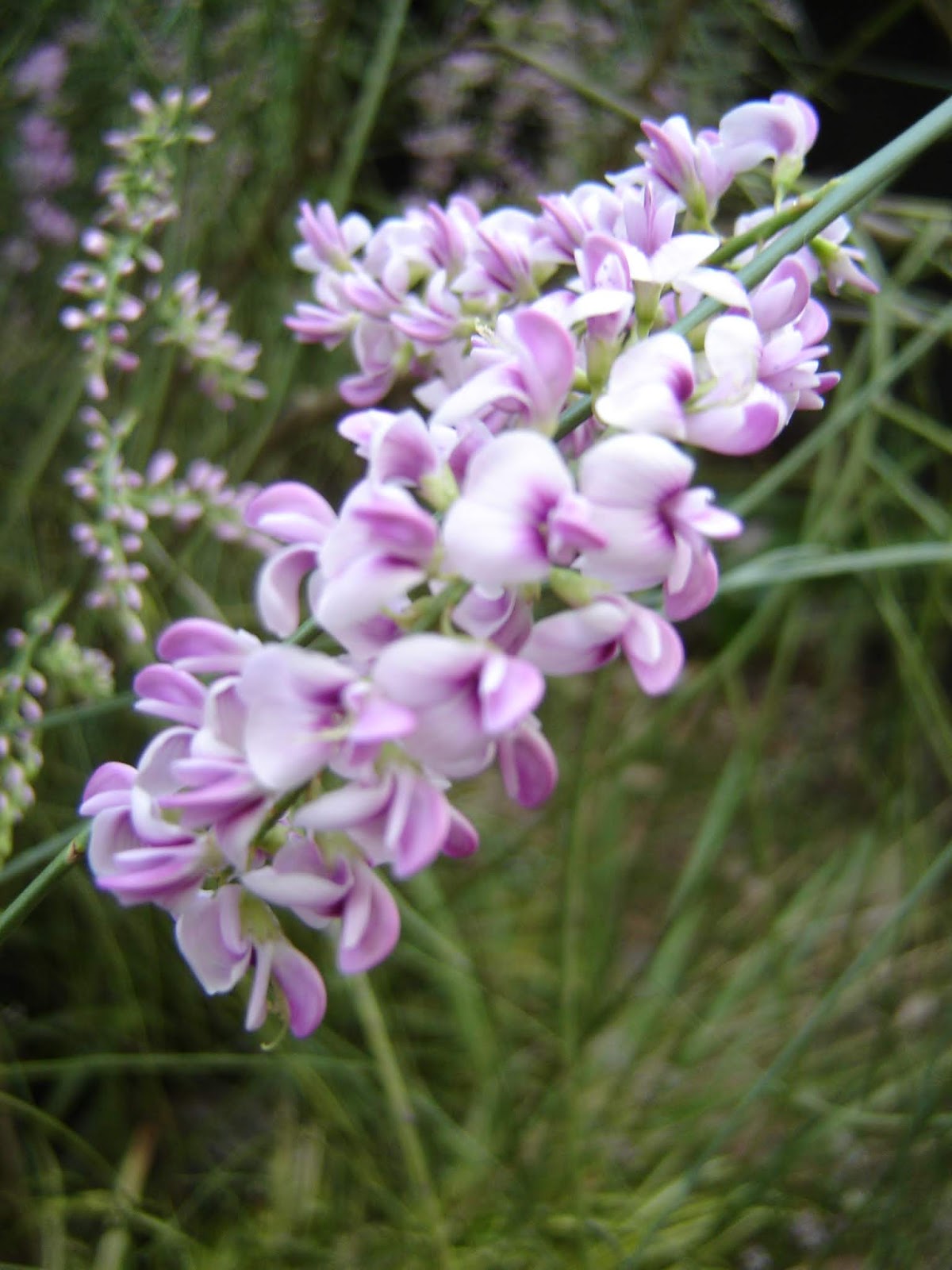
Carmichaelia glabrescens or the pink-flowering tree broom is endemic to the South Island, where it is found naturally in Marlborough - south of the Awatere Fault. Found in the Clarence and Waima Ure River Valley’s and on slopes of the seaward Kaikouras. It is found in lowland to montane area, in alluvial terraces, gorges, cliff faces and steep valley sides, from sea-level to 1200m asl. It is  an upright shrub to small tree up to 10m tall, with many slender weeping branches that are near leafless. It has masses of pink flowers with dark pink veins from November to January, that are great at attracting bees. It is very tolerant of dry and windy conditions, and frost. Carmichaelia glabrescens is very similar to Carmichaelia carmichaeliae. They have a similar growth habit, branchlets, and flowers. Carmichaelia carmichaeliae differs from Carmichaelia glabrescens by the pods being weakly constricted between the seeds, the seed outline often visible through the dry fruit wall, and the lower filaments are usually persistent on mature fruits. Carmichaelia glabrescens pods are shorter and broader, there are no constrictions between seeds, the seed outline is not visible through the fruit wall, and the lower filaments are usually absent from mature fruits.


Monday, 13 January 2020

Acaena inermis 'Purpurea', purple biddy biddy, bidibidi, or piripiri. It is a cultivated form of the endemic species Acaena inermis which is found in the South Island. It is a compact and hardy herbaceous groundcover with a one metre spread. It has a good tight habit and unlike most species of Acaena, it doesn't have barbs on the spines of its seed-heads. It likes a sunny or shady, moist position, and its attractive deep purple leaves creates a mass makes it an effective groundcover or ideal for a rock garden.
Feed with a slow release fertiliser to attain the best foliage colour.


Wednesday, 8 January 2020


Leptinella nana or pygmy button daisy is endemic to the North and South Islands. It is one of New Zealand’s most threatened species, and is nationally critical. In the North Island it is only known from the south western coastline at one site near Titahi Bay. In the South Island it is known from two sites, one at the Rai Valley, Marlborough and the other near Mount Pleasant (this population is under rocky bluffs on the Lyttelton Bluff Track), in the Port Hills, near Christchurch, Canterbury. Leptinella nana’s habitat varies from forest to coastal and montane cliff-top grassland, but common features are the need for disturbance patches, shelter, and supply of moisture. The species appears to have adopted a strategy of constant colonisation of small patches of bare ground and so occupies a highly dynamic and changing micro-habitat.  Leptinella nana is a very small, perennial herb which forms very low open mats. Easily distinguished from all other indigenous, small-leaved, diminutive Leptinella species by the branches which radiate from a central cluster, rhizome leaves crowded at the apex, short shorts absent or reduced, leaf bases, phyllaries and florets which lack dark veins; and by the slender rhizomes up to 0.5 mm diameter, membranous leaves, and yellow-green capitula up to 2 mm diameter.  It flowers from early spring to end of October and early autumn to early winter.  As it is very small it is easily lost by being over topped by taller plants. It does best in permanently open ground. An ideal plant, once established for high impact areas, though it seems to prefer a damp soil to do best.  This plant is extremely threatened, and the likely factors in any local extinction of Leptinella nana include loss of temporary open sites for colonisation, increased competition from other plants, opening up of protective vegetation allowing sites to dry out or become weedy, increased erosion or deposition of debris, excessive trampling by people and animals, loss of seed dispersal vectors like terrestrial birds and other animals, seed loss to unsuitable habitat, and indiscriminate herbicide use. Slugs are a threat to cultivated plants of Leptinella nana.


Tuesday, 7 January 2020


Poa colensoi, or blue tussock is endemic to the North, South and Stewart Islands. It is found from the Coromandel Peninsula southwards, and occurs in lowland to subalpine grasslands, herbfields and rocky places fro 300-1500m asl, but descends almost to sea level in South Otago. Poa colensoi is a small, rather stiff tussock of variable habit and colour. It grows to 20-25cm high, and is not very wide-spreading, It has very fine, tightly rolled leaves, that vary in colour from blue-green to an almost tawny colour. It has flower stems that rise well above the foliage. It is very hardy, and mainly grows in drier areas, so is great for sunny, drier positions in the garden. It can make a good front border plant, and is also suitable for a rock garden.


Monday, 16 December 2019

Entelea arborescens or whau is endemic to the Three Kings, North (including Little and Great Barrier Islands) and South Islands. In the North Island, whau is locally common from Te Paki to about Kawhia and Mahia Peninsula south of there it is known from a few sites in the eastern Wairarapa, at Paekakariki and Wellington. In the South Island it is confined to the Golden Bay area of North-West Nelson. Whau naturalises easily and has established south of these stations from bach and urban plantings. It grows in coastal to lowland forest or shrubland. Usually in open sites such as around recent slips, tree falls, cliff faces, boulder slopes, sand dunes or on the margins of streams, rivers, lagoons and lakes. Mostly near the coast however it may occur well inland in some places e.g., the Waikato River near Hamilton, Rotorua. Some inland and southern North island occurrences are thought to be derived from deliberate plantings by Maori. It is a shrub or small spreading tree up to 8 m tall with a trunk up to 25cm in diameter, with upright branches with very light weighted wood and firm grey bark. It has rather large soft green leaves, and produces an abundance of white flowers from October to February that are followed by spiky seed capsules. Whau is however, rather short-lived (up to 15 years) although once established if often self sows. Its wood is remarkably light, which when dry does not exceed half the weight of a piece of cork the same size. Maori used it to make floats for fishing nets, and the framework for small rafts. It is not threatened but however, recent field work gathering samples for a study into the possible past use of whau by Maori indicates that whau is much less common in the North Island than it once was. Browsing pressure from cattle, goats and horses, clearance of coastal scrub of housing and the spread of invasive woody shrubs and trees into many northern coastal areas may be threatening some populations.


Sunday, 8 December 2019

Leptinella calcarea is endemic to the South Island, and is found in north-west Nelson from Cape Farewell south to Kahurangi Point. It is found growing in coastal areas, on consolidated sand dunes, calcreous mudstones, limestones and conglomerate rock. This dioecious, perennial, tufted herb forms a loose to compact mat-like green carpet, and will occupy sites with minimal vegetation cover. Not invasive but will challenge other groundcovers if not maintained. It can be used as a lawn replacement in lower traffic areas and is very hardy.  It has small yellow flowers from August to November. It is best suited to full sun in a dryer well drained site. This naturally uncommon plant due to range restriction appears to be locally common within its only known habitats. There is no evidence that it has declined but most populations are rather small and could be at risk if current land use management practices in the area it occupies change.


Monday, 2 December 2019

Rhabdothamnus solandri , the New Zealand gloxinia which goes by a number of Maori names: taurepo, kaikaiatua, mata, matata, waiuatua
It is the only member of the genus Rhabdothamnus, and the only plant from the Gesneriaceae family native to New Zealand. It is endemic to the North Island and adjacent offshore islands, from Te Paki (North Cape) south to Manawatu Gorge, thence disjunct to just north of Pauatahanui Inlet, Porirua Harbour and at Smiths Creek near Makara, Wellington. This small twiggy shrub, which grows up to 2 metres tall, is found in coastal to lowland forests, near streams, or on banks. It has distinctive trumpet shaped flowers that range in colour from brick-red through to orange and more rarely a pale yellow, that occur throughout the year but peaking between October and February.
It is thought that in the past Rhabdothamnus solandri needed the long beaks of stitchbirds and bellbirds for pollination. It is now recorded that the colonist silvereye are nectar robbers of the flower by going through the side of the flower tube leaving holes. While doing this they partly maintain pollination for this species. It is frost tender, so would require protection if grown in parts of Christchurch.


Leptinella squalida subsp. mediana is endemic to the South and Stewart Islands. It is found from northwest Nelson and inland Marlborough to...